


A blog for parents who sense that something is harder for their child than it looks.
By Dinesh Kumar, Pediatric Occupational Therapist & Founder – Future Wings Clinic
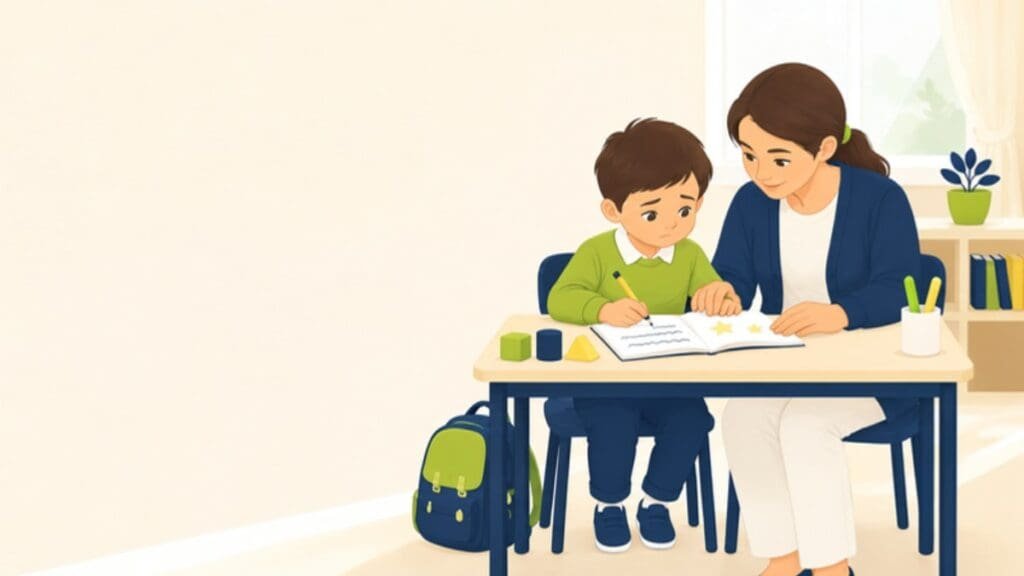
Some children look completely typical. They talk well, play happily, and seem bright. Then school begins, and parents hear about messy handwriting, unfinished work, or a child who cannot sit and focus. If your child is struggling at school and you cannot say why, occupational therapy may be worth a conversation.
What Occupational Therapy Means, in Simple Words
When I explain occupational therapy (OT) to parents, I keep it simple. OT helps a child gain as much independence as possible in daily life. For a child, daily life means play, school, and the routines of the day: eating, dressing, grooming, and keeping up in class.
An occupational therapist looks at what makes these things hard and works on it. You can read more about our occupational therapy service for children.
A Child Can Look Normal and Still Struggle
A child who talks and behaves normally at home can still find school difficult. Parents tell us about things like:
- Trouble copying from the blackboard.
- Difficulty forming sentences when writing.
- Writing some letters in reverse order.
- Not responding well to an instruction, or to a sequence of instructions.
Daily routines can show it too. A school morning has a sequence: wake up, go to the washroom, brush teeth, pack the bag. When a child finds that sequence hard, it is worth noticing.
Why Is My Child Struggling at School Even Though They Are Smart?
Parents often say, “He understands everything, but he cannot sit and write, or organise his toys, or finish a task.” When I hear this, I first ask why. Where exactly is the child struggling?
In a short case assessment, an occupational therapist usually looks at:
- Fine motor skills: using the small muscles of the hands.
- Visual perception: making sense of what the eyes see, such as copying from a board.
- Motor planning: working out and carrying out the steps of a movement.
- Attention: how long a child can stay with a task.
- Organisation: how the child sets up and completes a task.
The difficulty may also be something else: being overwhelmed by crowds or loud sounds, or struggling to keep attention for a long time. Once we know where the difficulty is, our sessions work on that, so the child can use their abilities better.
What Happens After the Assessment
Activities depend entirely on the child. We choose them by trial and observation, because every child is different. Parents also get a home plan.
We do not want your home to turn into a therapy room. That would overburden the child. What helps more is a steady routine through the week, and repeating the home plan.
Therapy is not only for children with a diagnosis. Sometimes it is simply support. It works best when what happens in sessions carries on at home.
“He Will Grow Out of It”
Many parents hear, “You are overthinking. He will be fine when he grows up.” You know your child’s strong and weak areas. A mother’s inner call is usually right.
People outside the family often react to what society says, or to how the child behaves at school. After six or seven months of improvement, those same people often start encouraging the child. Discussing your concern with a professional gives you an assessment, guidance and a home plan.
Overthinking is far better than neglecting. If you are thinking about your child’s difficulties, that is already good parenting.
Is There an Ideal Age?
There is no ideal age. By around two to two and a half, you can see whether a child plays in the way you would expect for that age. If play looks difficult, you can start looking for help then. The earlier the better. If it turns out that everything is normal, that is good news.
Children do grow at their own pace, and a few months up or down is common. But if the difficulty goes on for long, or something feels wrong, seek guidance.
Online or In Person?
We offer online consultations, and how much we can do online depends on the case. Some work needs hands-on therapy, which is why we prefer in-person sessions where possible.
There is no charge for visiting Future Wings Clinic in Sector 17, Dwarka. An assessment may be chargeable, and we tell families about fees in advance. Consultations are in English and Hindi. Schedule a visit or call +91 95555 19482.
Dinesh Kumar is a paediatric occupational therapist with more than 10 years of experience and the founder of Future Wings Clinic in Dwarka, New Delhi.
Related reading: How Do I Know If My Child Needs Occupational Therapy? and What Does Occupational Therapy for Children Actually Involve?



[…] Related reading: what an assessment looks at when a child struggles with writing, attention or routines is explained in child struggling at school? How occupational therapy helps. […]