

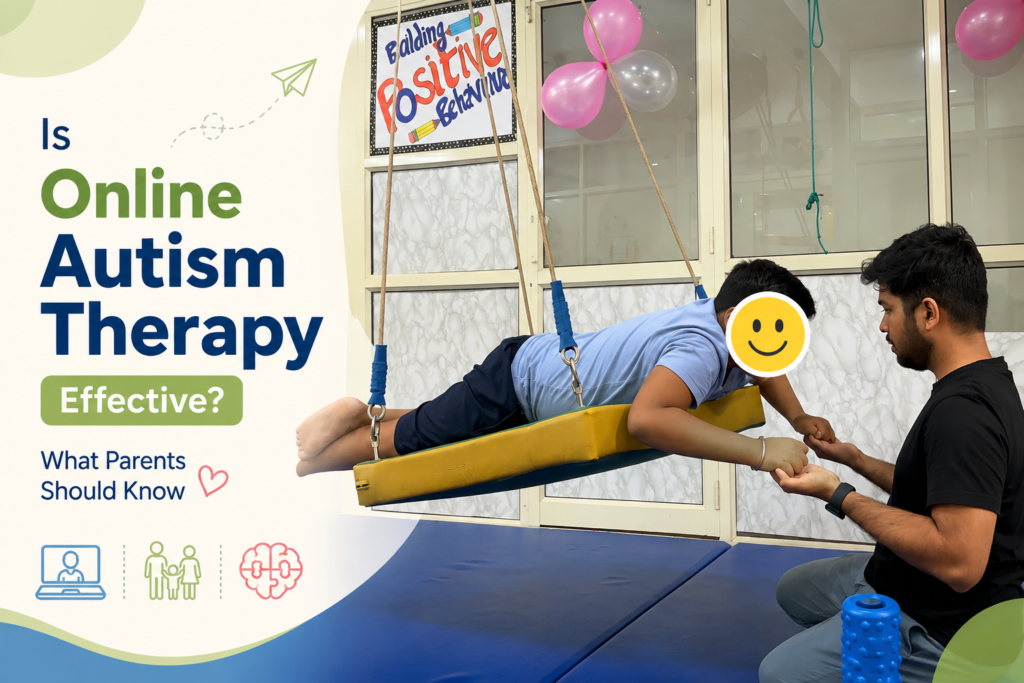
When parents search for Online Autism Therapy, they’re usually looking for one thing: hope. Maybe they’ve recently received an autism diagnosis, live in a city where good therapy centres aren’t easily accessible, or have been transferred to a remote location. The question they ask me is simple:
“Doctor, can online autism therapy really help my child?”
My answer is never a simple “yes” or “no.”
After working with children with Autism Spectrum Disorder (ASD) for many years, I’ve learnt that Online Autism Therapy can be incredibly effective—but only when it’s recommended for the right child, at the right stage, and with the right support from parents.
Let’s understand when it works, when it doesn’t, and what parents should realistically expect.
Is Online Autism Therapy Effective?
The answer is yes—but not for every child and not in every situation.
One of the biggest mistakes parents make is assuming online therapy can completely replace clinic-based intervention from day one.
In my experience, it shouldn’t.
For children who are just two, three, or four years old, beginning therapy entirely online is usually not the best approach. Young children often have shorter attention spans, limited communication skills, and may find it difficult to engage with a therapist through a screen.
For these children, face-to-face sessions help us build rapport, understand their sensory needs, and conduct a detailed assessment before deciding on the most appropriate intervention.
However, once that foundation is established, online sessions can become a valuable part of the therapy journey.
Which Children Benefit the Most?
Every child is different, but I’ve found that Online Autism Therapy works particularly well for children who:
- Are around five to six years of age or older.
- Have better communication and engagement skills.
- Can sit and participate in structured activities for a reasonable amount of time.
- Have parents who are actively involved in therapy.
Age alone isn’t the deciding factor.
What matters more is whether the child can meaningfully engage with the therapist and whether the family is willing to continue therapy activities at home.
Parents Become the Most Important Part of Therapy
This is probably the biggest difference between online and offline therapy.
In clinic-based sessions, therapists work directly with the child.
During online sessions, we spend a significant amount of time coaching the parents.
In many ways, parents become the therapist’s hands inside the home.
We discuss:
- Home-based activities.
- Daily routines.
- Behaviour management strategies.
- Communication techniques.
- Sensory activities.
- Progress since the previous session.
We also recommend therapy materials, share useful resources, and help families create an environment that supports learning.
The child may spend only a small portion of the online session interacting directly with me.
The rest of the session is often about empowering parents.
Because the more confident parents become, the faster children usually progress.
A Family That Taught Me the Value of Online Therapy
One family I’ll always remember had a six-year-old child with autism.
Shortly after beginning therapy, one of the parents was transferred to Kashmir for work.
Access to specialised therapy services there was extremely limited.
Instead of stopping intervention altogether, we changed our approach.
The family visited our clinic in Delhi for detailed assessments and follow-up reviews every few months.
Between those visits, we conducted online sessions two to three times every week.
Interestingly, the sessions weren’t centred entirely around the child.
They focused largely on coaching the parents.
We discussed the challenges they were facing at home, modified activities whenever required, and updated their home programme regularly.
Over the next few months, we saw meaningful improvements.
The child’s communication skills improved.
Classroom participation increased.
Daily routines became easier for the family to manage.
Even today, we continue with periodic online follow-up sessions.
This experience reinforced something I’ve always believed.
When parents become active partners, distance becomes much less of a barrier.
"Autism is part of my child. It’s not everything he is. My child is so much more than a diagnosis."
S.L. Coelho, Author
Common Myths About Online Autism Therapy
Many parents hesitate because they’ve heard misconceptions about online therapy.
One common myth is that online therapy is simply entertaining the child through a screen.
That isn’t true.
A structured online session is goal-oriented, individualised, and focused on practical strategies that parents can continue throughout the week.
Another misconception is that online therapy only works for older or “high-functioning” children.
While older children generally engage better online, younger children can also benefit—provided parents are actively involved and understand that the therapist is coaching them as much as the child.
At the same time, it’s important to remember that no therapist can physically guide a child through a screen.
That’s why parent participation isn’t optional.
It’s essential.
Should You Choose Online or Offline Therapy?
Parents often ask me which option is better.
Honestly, it depends entirely on your child’s individual needs.
If you’re able to visit a therapy centre regularly, I usually recommend starting with in-person sessions.
Direct observation, assessments, sensory activities, and motor interventions are often more effective face-to-face.
However, if you live in a remote area, a Tier 3 or Tier 4 city, or travel frequently because of work, online therapy is certainly better than delaying intervention.
In many situations, I recommend a hybrid approach.
For example:
- Initial assessment at the clinic.
- Weekly or fortnightly online follow-up sessions.
- Monthly or quarterly in-person reviews.
- Continuous home programme adjustments.
This combination often works remarkably well because it combines professional assessment with consistent parent coaching.
The Most Important Ingredient Isn’t the Screen
Whether therapy happens online or inside a clinic, one factor matters more than anything else.
Consistency.
Children learn through repetition.
Whether you’re attending sessions at the clinic or joining online from another city, continue practising the recommended activities at home.
Ask questions.
Stay involved.
Communicate with your therapist whenever you’re unsure.
Therapy isn’t about completing a certain number of sessions.
It’s about building skills every single day.
Final Thoughts
If you ask me whether Online Autism Therapy is effective, my answer is this:
It absolutely can be.
Not because the internet performs miracles.
But because when the right child, the right therapist, and committed parents work together, meaningful progress can happen—no matter where they are.
At Future Wings Clinic, we believe that therapy should adapt to the child’s needs, not the other way around. Sometimes that means regular clinic visits. Sometimes it means parent coaching through online sessions. And quite often, the best solution is a thoughtful combination of both.
Because every child deserves access to the right support, wherever they call home.